Crawling insect migration in Middle Tennessee accelerates under specific humidity and heat thresholds monitored by the National Weather Service Nashville Office . Homes built on crawlspaces in historic neighborhoods…
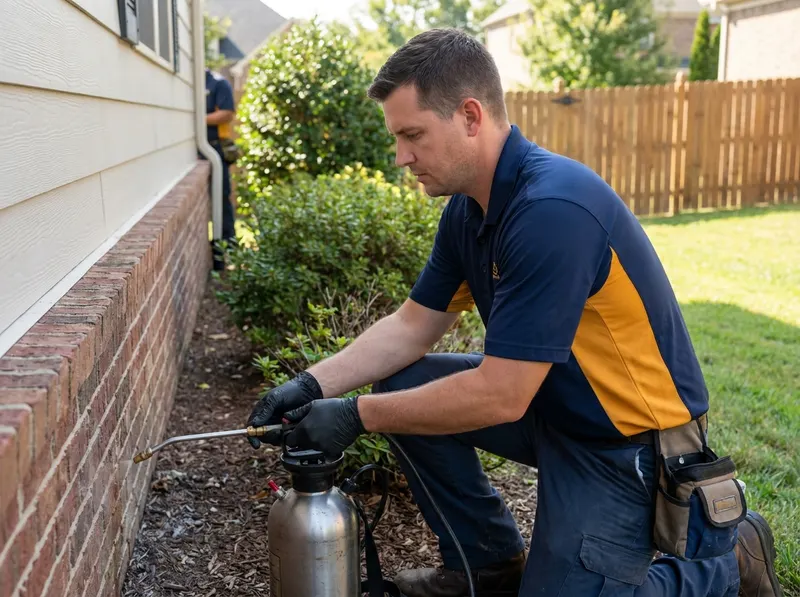
Crawling insect migration in Middle Tennessee accelerates under specific humidity and heat thresholds monitored by the National Weather Service Nashville Office. Homes built on crawlspaces in historic neighborhoods like East Nashville, Inglewood, and Belmont-Hillsboro frequently experience intrusion from subterranean pests entering through limestone foundation seams. A crawling pest perimeter barrier utilizes non-repellent liquid microencapsulations and water-resistant granular bands applied along the base of the structure. Standard liquid applications adhere to guidelines established by the EPA Office of Pesticide Programs, ensuring active ingredients remain bound to exterior masonry without washing into stormwater corridors near the Cumberland River or Shelby Bottoms Greenway.
Structural layout dictates product delivery. Slab-on-grade builds common throughout Donelson and The Nations require targeted expansion-joint crack injections, whereas raised basements and pier-and-beam foundations in Green Hills and 12 South necessitate treatments under the subfloor sill plate. According to structural pest management documentation from the Tennessee Department of Agriculture Pesticide Section, successful pest exclusion requires continuous coverage across subterranean entry points rather than random interior spot sprays. The trade-off between exterior perimeter barriers and internal treatments is clear: exterior bands stop infestations outside without depositing residues inside living rooms, while heavy interior treatments disrupt domestic routines and only kill pests after they have already crossed the threshold.
Implementation follows a standard three-stage process: 1. Clearing organic mulch and leaf litter 12 inches away from stem walls to expose bare soil; 2. Applying microencapsulated barrier materials meeting safety metrics outlined by the National Institute for Occupational Safety and Health; 3. Dusting crawlspace vents and utility penetrations using insoluble synthetic silica. For homeowners managing landscaping near riparian zones or municipal preserves like Radnor Lake State Natural Area or Percy Priest Lake, exterior applications avoid surface-water runoff per the standards set by the Tennessee Department of Environment and Conservation. This targeted perimeter defense for Tennessee homes prevents outdoor colonies from establishing interior harbors without requiring indoor evacuation.
Routine maintenance intervals correspond to regional precipitation patterns recorded by the USGS Water Resources Mission Area, as heavy rainfall breaks down topical barriers over a 60 to 90-day cycle. HarborFlare Insect Defense evaluates structural features, such as brick veneer weep holes, detached garages, and wood-to-ground contacts, to tailor the formulation. Properties located near dense canopy zones around Centennial Park Parthenon, Cheekwood Estate & Gardens, or Bicentennial Capitol Mall State Park face persistent pressure from wood-boring ants and wandering arachnids, making exterior perimeter isolation the most durable non-invasive line of defense against recurring seasonal invasions.
Every job gets a firm, written price after a free on-site visit.
For standards, safe disposal, and service guidance on pest control services in Nashville, TN, useful references include U.S. EPA, ENERGY STAR, U.S. Dept. of Energy, Consumer.gov, U.S. Census Bureau, and Google Maps. General consumer and small-business resources are available from USA.gov, Better Business Bureau, FTC Consumer Advice, U.S. Small Business Administration, and Ready.gov.
Tell us about your crawling pest perimeter barrier job in Nashville and we'll send a clear, written quote, usually the same day.
 HarborFlare Insect Defense