Davidson County sits firmly within the designated high-risk 'Termite Infestation Probability Zone' overseen by the U.S. Department of Housing and Urban Development . Native subterranean colonies dwell in the moist,…
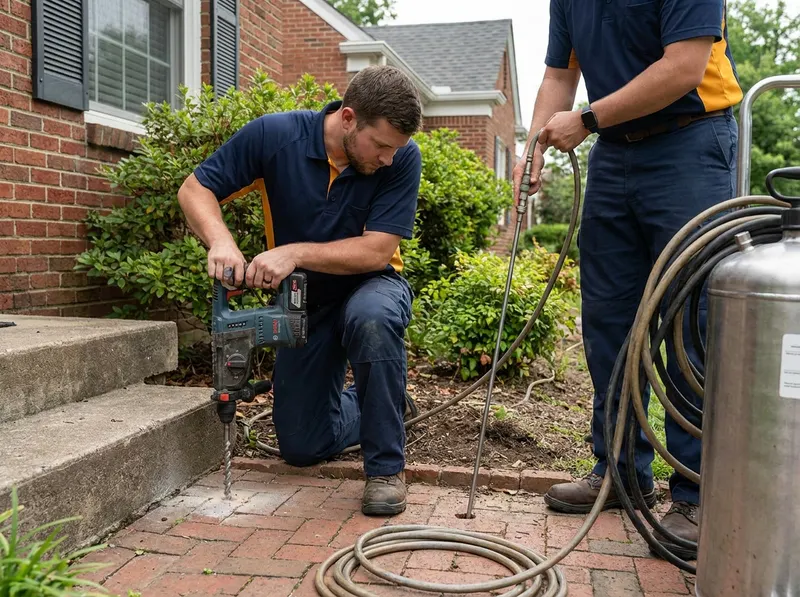
Davidson County sits firmly within the designated high-risk 'Termite Infestation Probability Zone' overseen by the U.S. Department of Housing and Urban Development. Native subterranean colonies dwell in the moist, dense clay earth native to Middle Tennessee, foraging upward into wood framing via foundation expansion gaps, hollow concrete masonry units (CMU), and perimeter plumbing penetrations. In older crawlspace-construction homes throughout East Nashville, Inglewood, and Belmont-Hillsboro, mud shelter tubes regularly ascend foundation piers to reach subfloor sills. Modern slab-on-grade homes in The Nations and Germantown face subterranean intrusion around perimeter weep screeds and utility conduits. Applying an uncalibrated hardware-store spray to live termite workings merely redirects the foragers to an adjacent wall stud without affecting the central underground brood chambers.
Effective subterranean termite defense requires building a continuous chemical barrier or deploying an engineered population-elimination matrix. Non-repellent liquid termiticides containing active ingredients registered through the U.S. Environmental Protection Agency, such as fipronil from BASF Pest Control Solutions, are injected via a continuous trench 6 inches wide by 6 inches deep around exterior foundation perimeters. When termites pass through this treated perimeter soil, they transfer the lethal non-repellent compound to nestmates through social grooming behaviors detailed by the Entomological Society of America. Properties framed over post-tensioned slabs or finished basements in Green Hills and 12 South often benefit from bait systems monitored under protocols supported by the PCT Magazine Research Portal. In-ground stations containing insect growth regulators like noviflumuron, engineered by Corteva Agriscience, suppress chitin production during molting cycles, leading to total colony collapse without requiring interior floor drilling.
Deciding between liquid soil barriers and underground bait matrices depends directly on architectural blueprints and proximity to sensitive local water bodies. Liquid treatments provide immediate, localized barrier rings around continuous stone or poured concrete, while baiting arrays are preferred on steep, rocky lots near Radnor Lake State Natural Area or properties abutting the Cumberland River basin where excessive soil moisture and limestone shelves hinder continuous trenching. Liquid protocols require trenching every 10 linear feet, utilizing roughly 4 gallons of diluted solution per 10 linear feet per foot of depth, according to standard label parameters enforced by the Tennessee Department of Agriculture. HarborFlare Insect Defense confirms structural dimensions during a visual evaluation; homeowners can direct questions to (615) 537-0362.
Homeowners can coordinate inspections in 4 linear steps:
1. Schedule a baseline crawlspace and perimeter inspection by dialing (615) 537-0362.
2. Receive a line-item map detailing linear footage, soil composition, and detected shelter tubes.
3. Complete the perimeter soil trenching, rod injection, or monitoring station installation.
4. Review the documented treatment record and establish an ongoing annual structural warranty.
Every job gets a firm, written price after a free on-site visit.
For standards, safe disposal, and service guidance on pest control services in Nashville, TN, useful references include U.S. EPA, ENERGY STAR, U.S. Dept. of Energy, Consumer.gov, U.S. Census Bureau, and Google Maps. General consumer and small-business resources are available from USA.gov, Better Business Bureau, FTC Consumer Advice, U.S. Small Business Administration, and Ready.gov.
Tell us about your subterranean termite treatment job in Nashville and we'll send a clear, written quote, usually the same day.
 HarborFlare Insect Defense